
Currently Empty: ₹0.00

Quick Answer
Choose a point drain if you’re renovating an existing bathroom without redoing the floor slope, want the lower-cost option, or have a small, simple bathroom layout. Choose a linear drain if you’re building new or fully re-tiling, want a modern uninterrupted floor look with larger tiles, or have a wider wet area that a single central point struggles to drain quickly. For most standard Indian “wet bathroom” layouts — where the whole floor is the wet area rather than a separate shower stall — a quality point drain with a proper water seal and cockroach trap is still the more practical, lower-risk choice unless you’re doing a full floor rebuild anyway.
What Is a Point Drain?
A point drain is a small, centrally located drain — usually round or square — where water flows in from all directions toward one point. It’s the traditional, most common drain type in Indian bathrooms, requiring the floor to slope evenly toward the center from all sides.
What Is a Linear Drain?
A linear drain is a long, narrow channel installed along one wall or edge of the wet area, with water flowing toward it from a single direction rather than converging from all sides. This allows a simpler, one-way floor slope and lets you use large-format tiles across the whole floor without needing to cut them into wedge shapes to meet a central point.
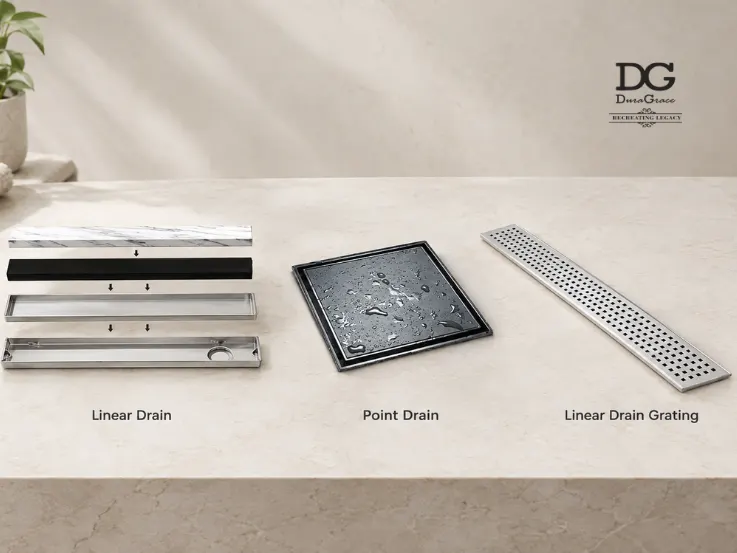
The Real Difference for Indian Bathrooms: Wet Floor vs Walk-In Shower
Almost every comparison guide online is written with a Western bathroom layout in mind — a separate glass-enclosed shower stall with its own small drainage area. That’s not how most Indian bathrooms are built. In a typical Indian bathroom, the entire floor is the wet area, water from bathing, mugs, and washing flows across the whole tiled floor, and there’s usually one central low point rather than an isolated shower zone.
This matters because a linear drain’s main advantage — simple, one-way slope for a defined shower zone — is less relevant when the whole floor needs to drain, unless you’re specifically redesigning the layout with a partitioned wet zone (increasingly common in premium renovations, but still not the default). For a standard whole-floor-wet Indian bathroom, a well-placed point drain at the true low point of the floor is often the simpler, more reliable solution. Linear drains earn their advantage clearly once you do have a defined shower zone with its own slope — which is common in larger or premium bathrooms, just not the majority of standard Indian layouts.
Linear vs Point Drain: Head-to-Head
| Factor | Point Drain | Linear Drain |
|---|---|---|
| Drainage capacity | Adequate for standard household flow | Higher — handles larger water volume faster |
| Water seal/odor control | Standard trap, reliable when maintained | Effective, but trap depth and design vary more by brand — check before buying |
| Cockroach trap | Widely available as a feature | Available, but confirm specifically — not universal on all linear models |
| Floor slope | Needs even four-way slope toward center | Needs a simpler one-way slope, easier with large tiles |
| Cleaning | Straightforward, small removable cover | Longer channel, needs more frequent clearing of the grate |
| Cost | Lower | Higher |
| Retrofit into existing bathroom | Easier — matches existing slope | Harder — usually needs floor/slope rework |
| Best for | Standard Indian wet-floor bathrooms, renovations, budget projects | New construction, defined shower zones, large-tile modern designs |
Drainage Capacity
A linear drain’s longer opening genuinely moves more water faster, which matters for larger bathrooms, multiple shower heads, or households where the bathroom sees heavy back-to-back use. For a standard single-point flow in a typical Indian bathroom, a correctly sized point drain handles normal daily use without issue — the capacity difference only becomes meaningful at higher water volumes than most homes generate.
Water Seal & Odor Control
This is the single most under-explained factor across every competitor page, and it’s arguably the most important one for day-to-day comfort. The trap beneath the drain holds a column of water that blocks sewer gas from rising back into the bathroom. If that water seal is too shallow, or evaporates during long dry spells (common if a bathroom isn’t used daily), smell comes back regardless of whether the drain above it is linear or point-shaped. Ask specifically about trap/water-seal depth when buying either type — the visible grille is not what prevents odor, the trap underneath it is.
Cockroach Trap & Anti-Siphon Features
A cockroach trap is a small internal flap or additional water-seal chamber that blocks insects from entering through the drain from the shared soil stack — a real, common issue in Indian apartment plumbing where drains connect to a shared vertical pipe running through multiple floors. This feature is common on point drains sold in India and increasingly available on linear drains too, but it’s not universal — confirm it explicitly rather than assuming every drain includes it.
Floor Slope Requirements
Point drains need the floor to slope evenly from all four sides toward the center — achievable, but it requires careful screeding, especially in a larger bathroom where an even four-way slope over a wide area is harder to execute well. Linear drains simplify this to a single-direction slope, which is genuinely easier to get right, particularly with large tiles that would otherwise need complex angled cuts to meet a central point drain cleanly.
Cleaning & Maintenance
A point drain’s cover is small and simple to lift and clean — hair and debris collect in one place. A linear drain’s channel is longer, meaning debris can collect along its length rather than in one spot, so it benefits from a slightly more regular clearing routine, though most modern linear drains have removable grates designed specifically to make this straightforward rather than difficult.
Cost
Point drains are generally the lower-cost option due to simpler design and less material. Linear drains cost more upfront, and if you’re retrofitting rather than building new, factor in the added cost of floor and slope rework — which is often a larger expense than the drain itself.
Design & Tile Flexibility
Linear drains let you run the same large-format tile across the whole floor without visual interruption or wedge-shaped cuts, which is the main reason they’re popular in premium, modern bathroom designs. Point drains work fine with any tile size but usually need at least some cut pieces near the drain to manage the slope.
New Construction vs Retrofit: Which Drain Fits Your Situation?
This is the factor competitor guides skip almost entirely, and it should usually come before the design preference.
- New construction or full floor rebuild: Either option is realistic. This is the right time to consider a linear drain if you want the tile-continuity look, since the floor slope can be planned correctly from the start.
- Renovation without floor rework: A point drain is almost always the practical choice, since it matches the existing slope. Installing a linear drain here usually means breaking and re-sloping the floor — a significant added cost and disruption just to change drain style.
The Decision Framework
- Are you rebuilding the floor anyway, or keeping the existing slope? Keeping existing slope → point drain. Rebuilding → either is viable.
- Do you have a defined shower zone, or is the whole floor the wet area? Whole floor wet (typical Indian layout) → point drain usually simpler. Defined shower zone → linear drain’s one-way slope shines.
- Is budget a primary constraint? Point drain is the lower-cost path in almost every scenario, especially on a retrofit.
- Do you want large-format tile with no visual interruption? Linear drain supports this cleanly; point drain works but needs some cut tiles near the drain.
- Have you confirmed water-seal depth and a cockroach trap on either option? This matters more than the shape — verify it regardless of which you choose.
Common Mistakes to Avoid
- Choosing a linear drain purely for looks in a retrofit without budgeting for the floor and slope rework it actually requires.
- Assuming every drain has a cockroach trap — confirm this explicitly with the seller rather than assuming it’s standard.
- Ignoring water-seal depth — the drain shape gets all the attention, but a shallow trap causes odor regardless of whether it’s linear or point.
- Under-sizing a point drain in a large or heavily-used bathroom, leading to slow drainage that gets blamed on “the wrong drain type” when it’s actually a sizing issue.
- Not planning slope direction before tiling — this decision has to happen before the floor is laid, not after.
Final Verdict
The linear-vs-point decision gets treated as a style choice online, but for most Indian bathrooms it’s really a layout and construction-stage question first, and a style choice second. If you’re keeping your existing floor and slope, a point drain with a verified water seal and cockroach trap is the lower-cost, lower-risk choice. If you’re rebuilding the floor anyway and want the clean, uninterrupted tile look, a linear drain is worth the extra cost — just confirm the trap depth and odor-control details before you buy, because that’s the detail that actually determines whether your bathroom smells fresh, not the shape of the grille on top.